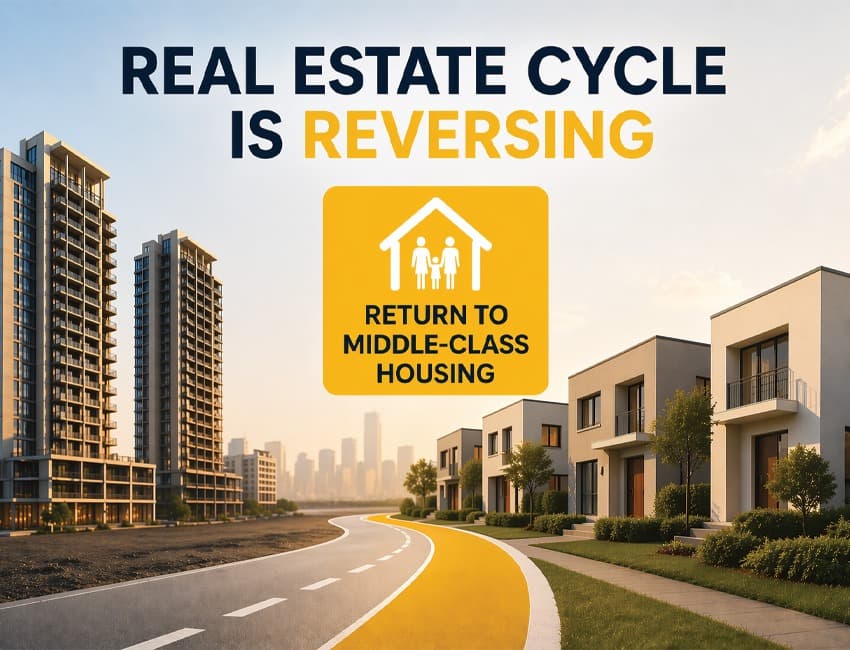
It is believed that the Indian real estate industry has seen a dramatic shift to luxury housing following COVID-19, the COVID-19 pandemic. It could currently be in the midst of a period of adjustment. Based on market trends and experts' insights, the pattern that preferred larger and luxurious homes, such as 4BHK and 3BHK models, seems to be changing. This could mean a renewed attention to mid-segment and affordable housing, specifically for often overlooked middle-class homeowners.
Luxury Boom After the Pandemic
In the aftermath of the outbreak, the housing market underwent an unanticipated change. As remote work became more commonplace and more people stayed at home, homeowners began focusing on more spacious living areas. This resulted in a rise in the demand for large homes in cities with major metropolitan areas, including Mumbai.
The developers quickly adjusted to this need. Developers changed their strategies to building larger apartments, which included 3BHK, 2BHK, and even units with 4BHK. These designs not only matched the changing preferences of buyers but also resulted in higher profits for developers. In the end, smaller houses like 1BHK were slowly pushed aside.
This trend was further supported by the rising salaries of certain groups, such as entrepreneurs and investors in the stock market, who gained from the post-pandemic economic recovery. This resulted in a strong market for buyers who were that was willing to invest in luxury housing.
Sharp Decline in 1BHK Supply
But recent data suggests an increase in the number of homes that are smaller. According to market trackers for the housing market that have been tracking the market, the number of new homes that were launched as 1 BHK properties in Mumbai decreased by 50% by 2025. The total dropped to 9,786 units, as compared to the previous annual average of about 220,000 units.
This dramatic reduction demonstrates how builders have reduced the importance of affordable housing. This has led to an increasing gap between the available homes on the marketplace and how much a huge segment of buyers can afford.
The average cost of a newly-launched property in Mumbai has reached nearly three crore. This price hike has effectively put budget-friendly options out of the reach of the majority of middle-class families, particularly in areas that are central and well-connected.
Affordability Crisis Deepens
The effects of this shift are beginning to be seen. In the central areas of Mumbai, the search for a real 1BHK property for under one crore has become very difficult. Cheap options are usually restricted to areas that are peripheral, such as Thane, Mira Road, and the extended corridors that lead to Karjat.
However, there is still concern about the quality and dimensions of units that are available. Some buyers have noted that a lot of projects advertised as 2BHK homes generally feature the same carpet that older homes with 1BHK, which are usually around 350 square feet. This has led to questions regarding transparency and the value of the money.
In addition, homeowners have expressed their displeasure with the style and living space of smaller houses. Some of the most common complaints include:
-
Very small kitchens
-
Bathrooms are poorly designed and designed
-
There are no balconies
-
There isn't enough parking or no facilities
These issues have made homes that cost more than $1 million feel inadequate to meet the modern standards of living.
Social Sentiment Reflects Frustration
The increasing cost of living has led to a wide discussion among homeowners and other industry experts. A lot of potential buyers feel the market has deviated from the reality of the typical Indian family.
A few have publicly critiqued the current situation of the housing market in Mumbai and have claimed that it is prohibitive for a large portion of Mumbai's residents. Others have pointed out the swift price hikes in suburbs. For example, 2BHK apartments in locations such as Bhayandar currently start at Rs 1.3 to Rs 1.5 crore. These prices have increased rapidly in the span of a few years.
Advertising for luxury homes has been met with skepticism. Luxury projects that offer 4BHK units for the range of Rs8-9 crore in areas like Borivali are received with sarcasm and criticism as many question whether developers are too focused on buyers of high-end.
Changing Aspirations vs Ground Reality
Although some experts in the industry claim that the needs of middle-class people have changed, suggesting that consumers now want at least 2BHK houses, the financial real-world evidence is different.
The issue is that it's clear there's a disconnect between the aspirations of buyers and their purchasing power. Although many buyers would like larger houses, their incomes are not always sufficient to support large-value investments. This has resulted in slower sales growth in certain sections of the marketplace.
Experts stress that demand isn't just about desire, but must be supported by affordability. If there isn't enough purchasing power, even aspirational demand will not keep pace with market growth.
Signs of a Market Correction
In the real estate sector, as it is advancing towards 2026, first indications of a slowdown are appearing. The speed of sales in certain high-end segments is beginning to decrease, and concerns regarding affordability are becoming more evident.
The industry has prompted analysts to forecast a possible change in the developer's strategies. If inventory within the luxurious sector builds up, and demand improves, developers may be compelled to reconsider the middle-income housing segment.
"Forgotten middle class "forgotten middle class" could be the main focus of developers. This could include:
-
The supply of compact 1BHK and 2BHK units that are compact is growing
-
With more affordable housing choices
-
Design efficiency is improved to maximize space
-
Growing projects in the emerging urban and suburban areas
A Nationwide Trend
The challenge of affordability is not restricted to Mumbai. Similar trends are emerging in cities such as Pune, Hyderabad, and Bengaluru. In these cities, as well, the availability of affordable housing hasn't kept up with the demand.
While the government-backed housing initiatives attempt to close this gap, participation from the private sector is essential for a large-scale impact. Developers must balance the need for profit and inclusion to guarantee long-term growth.
The Road Ahead
This Indian real estate market is well-known for its cycles and the current stage could be the start of a new phase. If the forecasts are true, the next decade may see a shift in the housing market across various segments.
For middle-class buyers, it could provide new hope for homeownership within the city boundaries. But the speed and magnitude of this change will depend on a variety of variables, including:
-
The rate of interest
-
Growth in the economy and levels of income
-
Incentives and policies of the government
-
Response of developers to market dynamics
Conclusion
The boom in real estate after the pandemic caused a sharp shift towards luxury homes, which left an important gap between the affordable and luxury segments. As affordability pressures increase and sales slow, it appears that the market may be in a transitional phase.
Read More: Goregaon Penthouse Breaks Record with an amount of Rs 55 crore in the Western Suburbs
Source: India Times
.jpeg&w=3840&q=75)