India's Office Leasing Rises 35% in Q3, Delhi-NCR and Chennai Drive Growth
Industry Reports & Surveys

India's Office Leasing Rises 35% in Q3, Delhi-NCR and Chennai Drive Growth

The office real estate industry in India has seen a remarkable performance during the period between July and September of 2025, and net leasing activity is gro...

October 4, 2025
|
74
|
0
|

India's Office Leasing Rises 35% in Q3, Delhi-NCR and Chennai Drive Growth

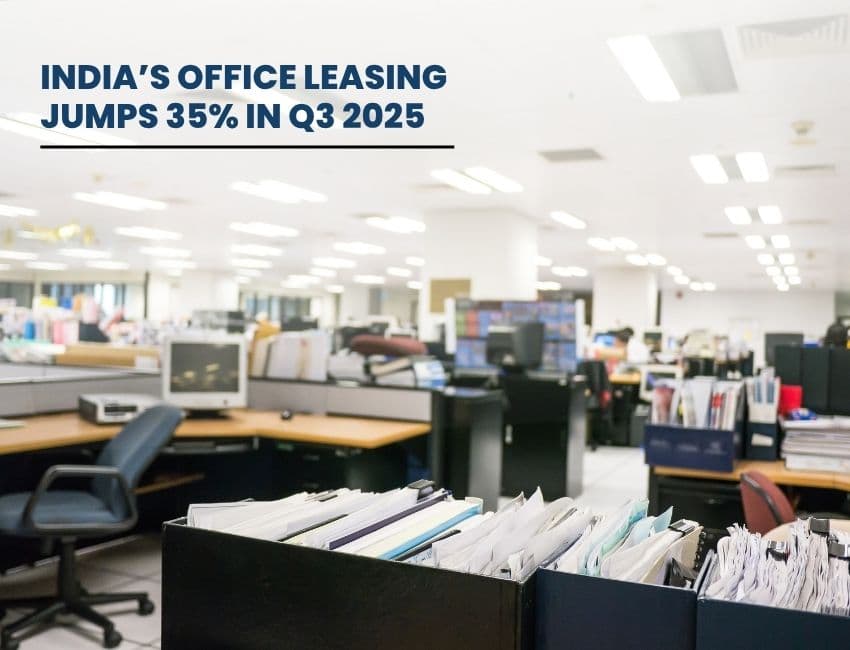
The office real estate industry in India has seen a remarkable performance during the period between July and September of 2025, and net leasing activity is growing by 35% over the course of the year across the nation's top 8 cities. According to real estate expert Cushman & Wakefield (C&W), the net absorption was 16.25 million square feet in the quarter, which reflects a heightened demand from both international and domestic businesses.

The increase in demand demonstrates the industry's resilience as new take-ups of space make up a large portion of leases, indicating growing corporate footprints and not simply renewals. According to industry experts, it is a sign of the market's transition into an obvious expansionary cycle, which is being fueled by the scale into Global Capability Centers (GCCs) and the rise in startup activity and a surge in engineering and manufacturing investment.

The Delhi-NCR region has seen strong gains, Chennai, and Pune

Of all the cities in the region, Delhi-NCR, Chennai, and Pune have had the best performances. In Delhi, net leases have more than tripled to 3.79 million sq ft, compared with 1.52 million sq ft in the same time frame in the previous year. Chennai witnessed a tenfold rise to 2.28 million sq feet from less than 0.47 million sq feet during the prior year's July-September quarter. Pune also saw significant growth as leasing volumes grew 64 percent up to 2.54 million sq feet, in comparison to 1.55 million sq feet.

Hyderabad has also seen steady growth in net leasing, reaching 1.42 million sq ft, which is a 7% rise over the previous calendar year's 1.32 million sq ft. Kolkata expanded modestly to 0.43 million sq feet from 0.37 million sq feet, while Ahmedabad increased marginally by 0.21 million square feet, up from 0.20 million sq feet.

These developments signal not just an increase in demand but also a growing confidence among occupiers in areas previously thought of as less important than Bengaluru or Mumbai. The industry watchers have noted that occupiers are diversifying their operations across multiple cities, as they focus on the continuity of their business, cost reduction, and access to broader potential talent pools.

Declines in Mumbai and Bengaluru

In contrast, India's traditional front-runners--Bengaluru and Mumbai--saw declines in net absorption. Bengaluru's office demand fell 14%, dropping to 3.46 million square feet, compared to 4.01 million square feet during the corresponding timeframe in the previous year. Mumbai saw a much more dramatic decline of 19% falling to 2.13 million sq ft, down from 2.64 million sq ft.

Market analysts attribute this decline to a combination of high base levels, the limited supply of prime locations, and the cautious take-up of space by a few financial and technology services companies in the face of global economic challenges. Despite the downturn in the fourth quarter, however, both cities continue to draw a large number of occupiers because they have well-established hubs for commercial activity as well as infrastructures for talent.

Also Read: Mumbai’s real estate market continues to boom

Expert insight

Anshul Jain, Chief Executive of India, SEA & APAC Office and Retail at Cushman & Wakefield, highlighted the structural strength that is driving the market's growth. "Over 80 per cent of Q3 leasing was driven by fresh take-up--a clear sign of occupiers growing their footprint, not merely renewing space," Jain declared. Jain added that the long-term economic fundamentals are solid and are supported by GCC expansions, more startup activity, and an increase in the engineering and manufacturing sectors, driving demand.

Veera Babu, Executive Managing Director Tenant Representation - India at C&W, emphasized that net absorption is a reliable gauge of demand. "This quarter's figures show that the momentum in the office sector in India is extensive and lasting. Cities like Delhi-NCR, Pune, and Chennai set new standards for leasing," Babu said. Babu was also adamant that a large pipeline of deals that are active indicates this could be part of a long-term structural expansion cycle and not an isolated event.

The outlook for the sector

Analysts from the industry expect leasing momentum to grow in the next quarters as India strengthens its position as a popular business location. With multinational companies expanding their GCC operations, local firms expanding, and new businesses looking to expand their workspaces, the demand is likely to continue rising. Policies aimed at attracting investment and simplifying business operations are likely to help the market for office real estate.

While the slowdown within Mumbai and Bengaluru might continue to persist in the near term Analysts believe they are likely to recover their strength thanks to their well-established business environment. In the end, the outlook for the office sector in India is positive, with a large-scale expansion underway in many cities.

The July-September figures for leasing confirm that India's office real property is now entering a new era of expansion in its structure, setting the conditions for long-term optimism among the tenants and a multi-city diversification. With 16.25 million square feet, this quarter is one of the best results in recent years, which highlights the market's resilience and potential for the long term.

Source: Business World
 

Leave Your Comment

Trending News Post

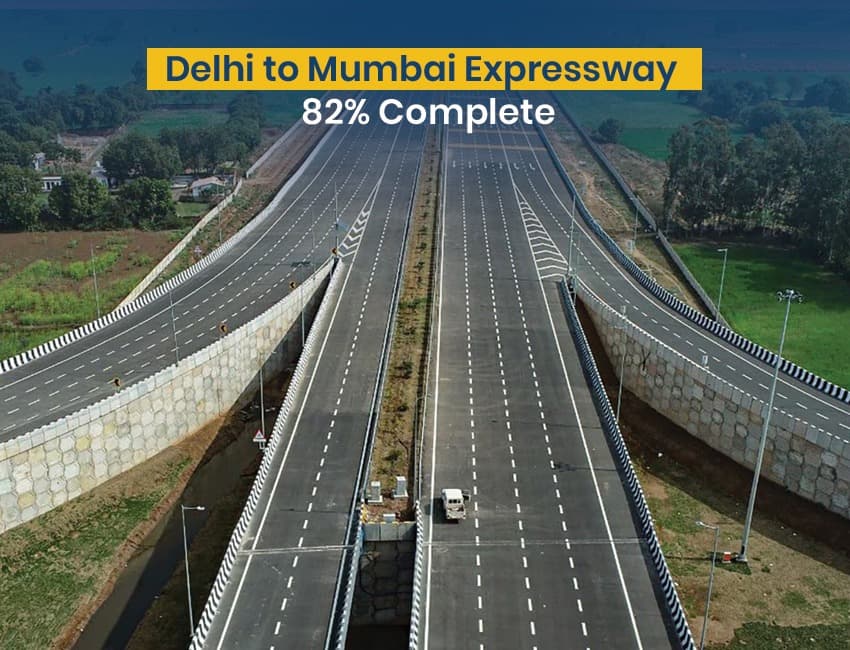
Delhi-Mumbai Expressway 82 percent Complete

Delhi-Mumbai Expressway 82 percent Complete

The construction of the Delhi-Mumbai Expressway, which is set to become India’s longest Greenfield Expressway, is advancing rapidly. Union Minister for Road Transport and Highways, Nitin Gadkari, announced that the project is expected to be completed by October 2025 in a recent update to the Rajya Sabha. The extensive infrastructure project covers a total length of 1,386 kilometers and is being developed in 53 segments. As of June 2024, work on 26 of these segments has been finalized, resulting in a physical completion rate of 82%. To date, 1,136 kilometers of the expressway have been constructed. This critical project aims to improve connectivity between major economic centers including Delhi, Uttar Pradesh, Haryana, Rajasthan, Madhya Pradesh, Gujarat, and Maharashtra. According to the detailed project report, the new expressway will shorten the distance between Delhi and the Jawaharlal Nehru Port Trust (JNPT) in Mumbai by approximately 180 kilometers. Additionally, it is projected to reduce travel time by up to 50% for various destinations along the route. In a related update, Gadkari also reported that as of June 30, 2024, there are 983 user fee plazas currently operational on National Highways throughout India

August 20, 2024|
1028
|
1
Sohna to Get Metro Connectivity Soon!

Sohna to Get Metro Connectivity Soon!

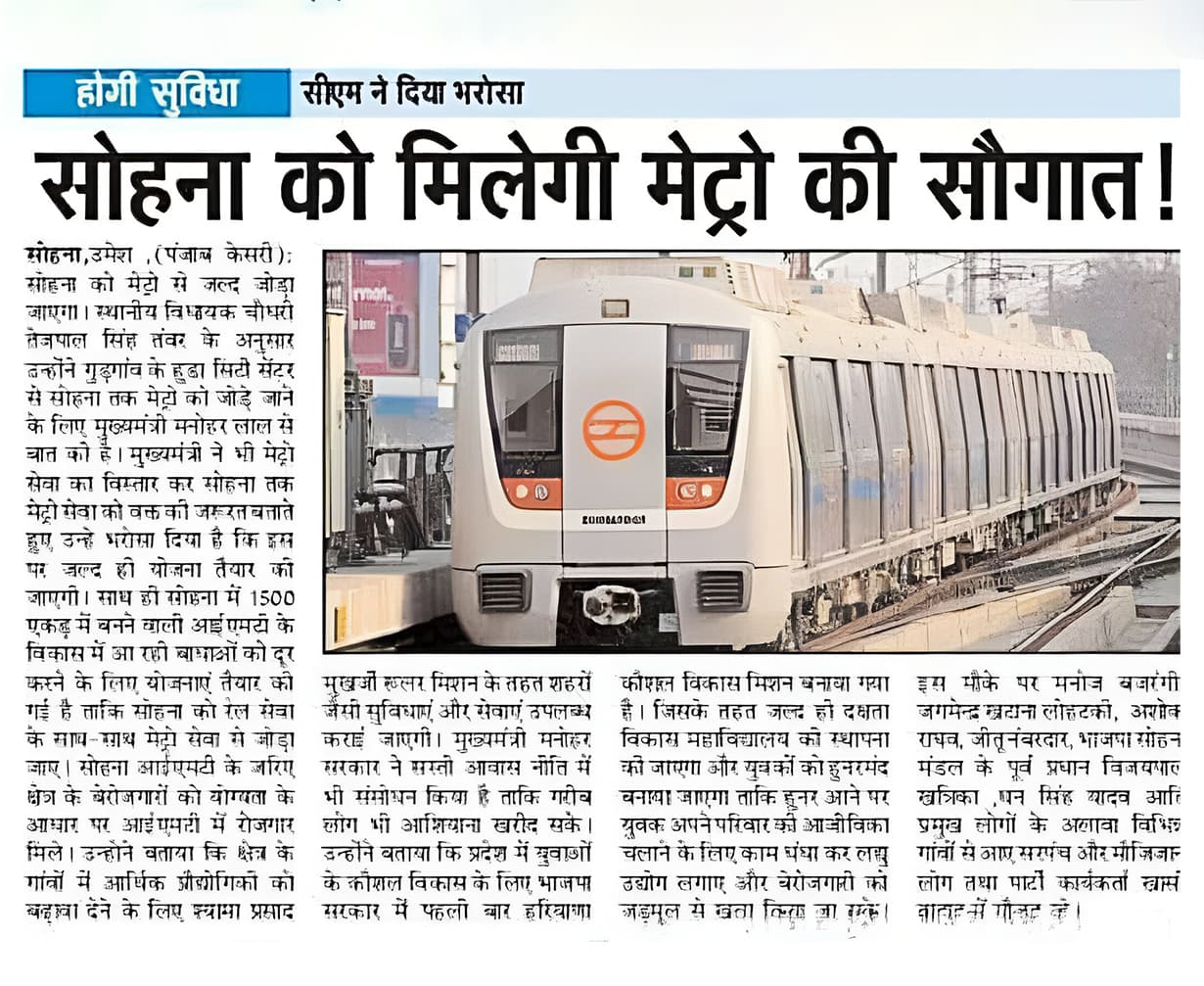
Location: Sohna, Gurugram (Panchayat Kesari) Great news for Sohna residents! The long-awaited metro extension from Gurugram's HUDA City Center to Sohna is set to become a reality. Haryana Chief Minister Manohar Lal Khattar has assured that the government is working towards this much-needed infrastructure development. Key Highlights:✅ Metro Extension Approved: Plans to connect Sohna with Gurugram via metro are in progress. ✅ Boost to Development: With 1,500 acres of land earmarked for IT and industrial projects, metro connectivity will enhance economic growth. ✅ Government’s Commitment: The Chief Minister has emphasized fast-tracking approvals and securing funds for the project. ✅ Better Connectivity & Investment Opportunities: The metro will improve travel convenience and attract investors to Sohna’s expanding residential and commercial sectors. Experts believe that the metro extension will not only ease daily commuting but also significantly reduce traffic congestion on major roads connecting Gurugram and Sohna. Additionally, real estate prices in the region are expected to rise, making it a prime location for future development. Authorities are actively working to speed up the process, ensuring that Sohna gets its metro connectivity soon. Stay tuned for more updates!

March 27, 2025|
874
|
0
Palam Vihar-Dwarka Metro Phase Set to Launch

Palam Vihar-Dwarka Metro Phase Set to Launch

The Haryana Mass Rapid Transport Corporation (HMRTC) is making significant strides in the development of the Palam Vihar to Dwarka metro extension project. Senior officials have indicated that plans are underway to finalize the alignment and locations for this much-anticipated extension, which aims to connect Palam Vihar in Gurugram to Dwarka’s Sector 21.   The project will feature key interchanges: one at the Palam Vihar station connecting with the Gurugram Metro corridor, another at the IECC station of the Airport Express, and a final interchange at the Dwarka Sector 21 metro station. The alignment for the project has been settled, but discussions are ongoing regarding the placement of the last metro station. Options under consideration include positioning the station near the Bijwasan railway station or the interstate bus terminal in Dwarka. The decision will hinge on passenger convenience and preferences for connectivity between trains and buses.   With an estimated cost of ₹1,687 crore, the project was approved by the Haryana government in October 2022. Haryana is set to cover ₹1,541 crore of this cost. Once the final alignment is decided, the project will be expedited and sent for Union government approval.   The extension will span 8.4 kilometers, with 5 kilometers running from Palam Vihar to Sector 111 in Gurugram and the remaining 3.4 kilometers extending into Delhi. The route will include seven elevated metro stations: Chauma village, Sector 110-A, Sector 111, Sector 28 in Dwarka, IECC, and Dwarka Sector 21.   The detailed project report outlines that the metro stations will be elevated, with an interchange planned at Rezangla Chowk in Palam Vihar to facilitate connections with the main Gurugram Metro line extending from Huda City Centre to Cyber City via Old Gurugram and Palam Vihar.

August 11, 2024|
647
|
0
Buying Land in Haryana Will Be Expensive, New Rail Project to Transform Delhi-NCR

Buying Land in Haryana Will Be Expensive, New Rail Project to Transform Delhi-NCR

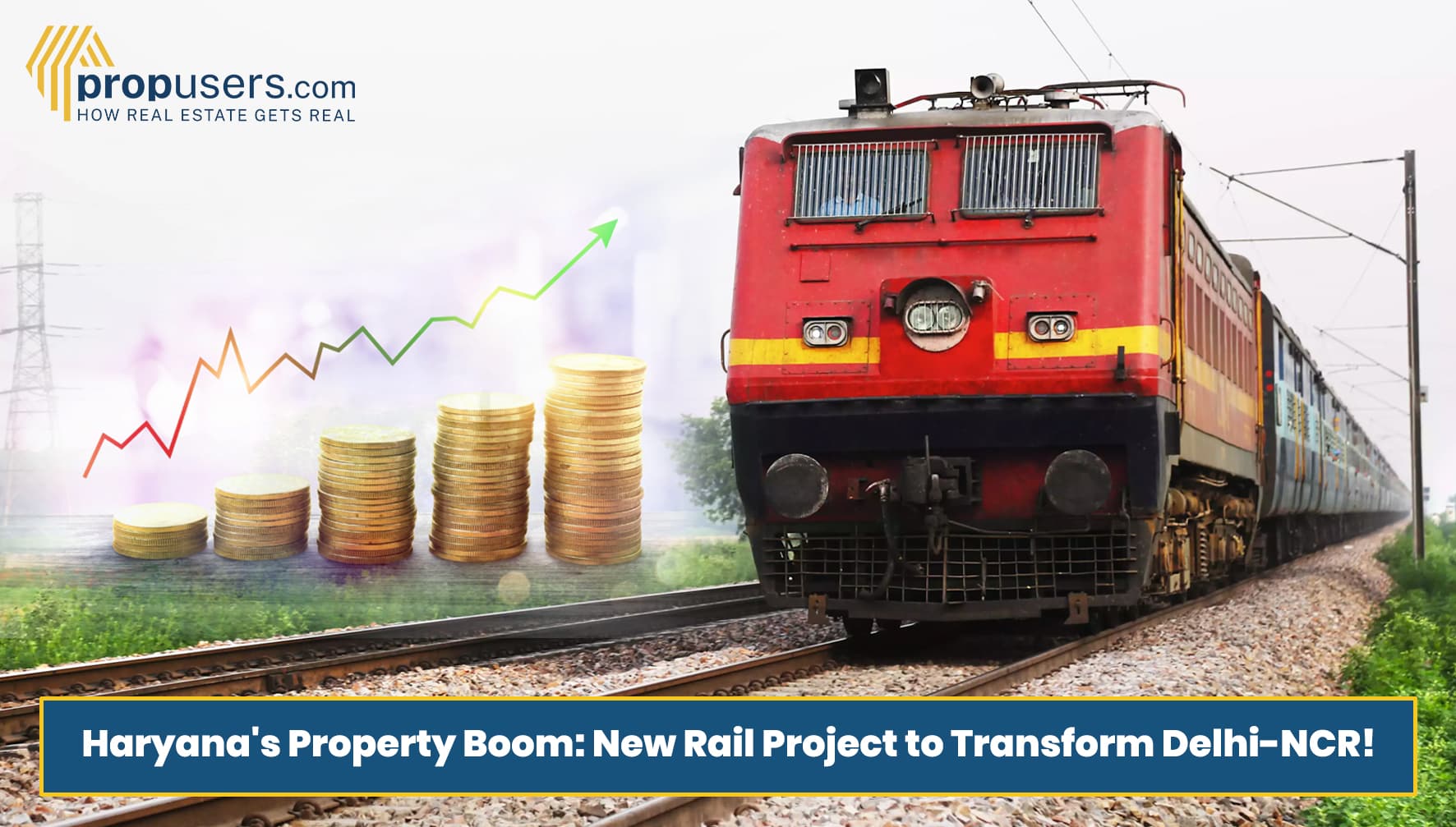
A major transformation is coming to Haryana! The new Haryana Orbital Rail Corridor project is progressing rapidly, aiming to reduce traffic congestion in Delhi-NCR and improve railway connectivity in key regions of Haryana. Once completed, this project will boost industrial and commercial activities, directly impacting property prices in the area. Which Areas Will Have the New Railway Line?This railway project will span 126 km from Palwal to Manesar, extending up to Sonipat. In the first phase, a 29.5 km double electric railway line from Dhullawat to Badshah will be built, enhancing railway connectivity in Gurugram and surrounding areas. The railway line expansion will cover the following districts:✅ Sonipat✅ Gurugram✅ Sohna✅ Palwal✅ Jhajjar(More railway stations will be developed in various regions) Why Will Land Prices Increase?Whenever railway connectivity improves, property prices tend to rise. Gurugram, Sonipat, Palwal, and Jhajjar could become new hotspots for investors. In the coming years, buying land in these areas may become more expensive. ₹5700 Crore Project That Will Transform Haryana's FutureReduced Traffic: The corridor will help ease heavy traffic congestion in Delhi-NCR.Shorter Travel Time: High-speed trains will allow passengers to reach their destinations faster.New Employment Opportunities: The growth of industries and businesses will generate new jobs.Environmental Protection: The use of electric trains will reduce pollution. When Will the Haryana Orbital Rail Corridor Be Completed?According to government reports, this railway project is expected to be completed by 2026. If construction progresses swiftly, the project may be finished even before the scheduled time.

March 17, 2025|
627
|
0
Budget 2025: New opportunities and policy reforms for real estate sector

Budget 2025: New opportunities and policy reforms for real estate sector

Budget 2025 presented by the Government of India has opened the doors of new possibilities in the real estate sector. From income tax reforms to the development of urban infrastructure, many important announcements have been made in this budget, which will prove beneficial for investors, home buyers and developers.1 Middle-Class tax relief - it will be easy to buy a house✅ Income tax free of up to 12 lakhs - This will give more spending income to consumers, so that they can give priority to decisions like savings, investment and home buying.✅ Increasing sense of housing - Additional income will reduce the burden of down payment and EMI for middle class people, so that they will be able to buy their first property easily.✅ Tax exemption on two properties-Now taxpayers can claim zero annual evaluation on two self-conscious properties, which will promote real estate investment.2 Encourage Real Estate Investment✅ TDS simplification on rent - The annual limit of tax deduction (TDS) at the rent on rent has been increased from ₹ 2.40 lakh to ₹ 6 lakh, which will provide relief to tenants and landlords.✅Tax exemption on interest - tax exemption on interest income for senior citizens has been increased from ₹ 50,000 to ₹ 1 lakh, which will strengthen their investment plans.3 Urban infrastructure expansion - new real estate hotspots✅ Urban Development Fund of Rs 1 lakh crore - Modern infrastructure, facilities and services will be developed in urban areas, which will provide new heights to the real estate sector.✅ Urban Extension under PPP model-The government has prepared a three-year project plan under the Public-Private Partnership (PPP), which will increase residential and commercial investment opportunities in new developing areas.✅ Tier-2 and Tier-3 GCC centers in cities-The establishment of Global Capacity Centers (GCC) will increase the demand for grade-A office space in these cities, which will give new pace to the real estate sector.4 Relief for threatened residential projectsAllocation of ₹ 15,000 crore for Swamih Fund 2 -✅ More than 1 lakh home buyers will benefit.✅ 40,000 new residential units will be completed in 2025.✅ It will help to complete the already incomplete projects.5 The scope of real estate will increase due to improvement in connectivity✅ Expansion of flight plan-120 new destinations will be added over the next 10 years, which will increase the demand for real estate in Tier-2 and Tier-3 cities.✅ PM Gati Shakti Data Access - Government will develop major tourist destinations, which will create new opportunities for hotels and commercial properties.ConclusionThe real estate sector will get much awaited boost from the budget 2025.✅ It will be easy to buy a house with tax relief.✅ New hotspots will develop by improving infrastructure.✅ Demand for residential and commercial properties will increase rapidly.Through this budget, the real estate sector in India will get new opportunities for stability, encouragement and investment.

February 20, 2025|
524
|
0
UER 2 Revolutionizes Connectivity

UER 2 Revolutionizes Connectivity

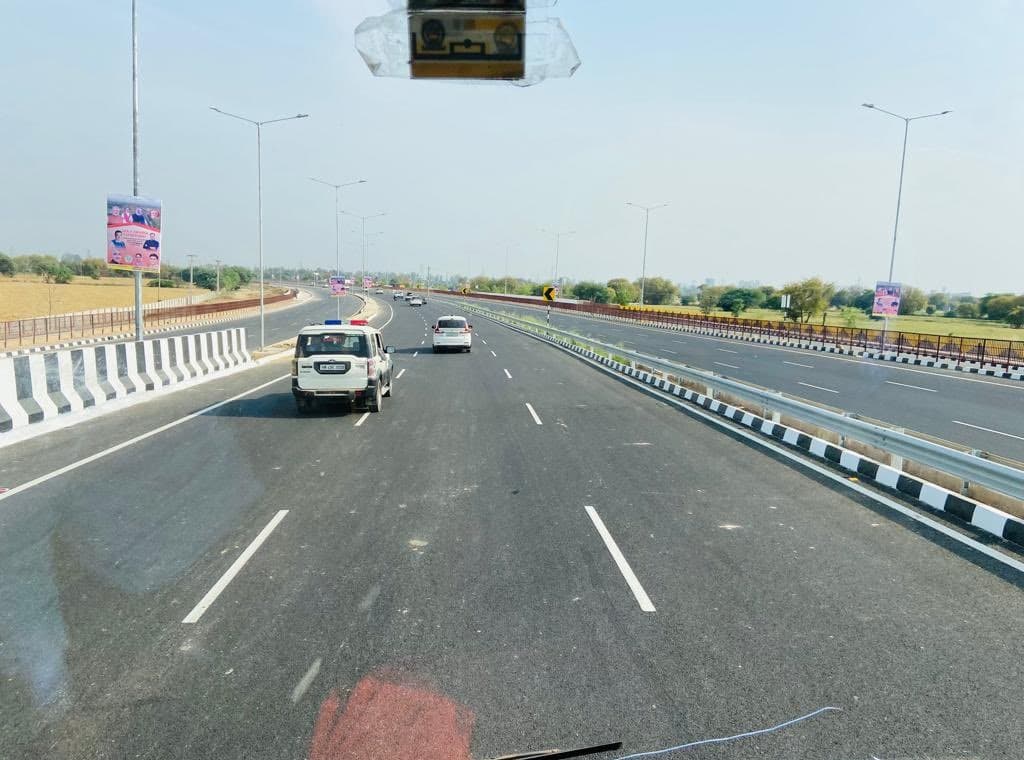
The UER 2 (Urban Extension Road 2) is almost ready and is expected to make traveling in the National Capital Region (NCR) much easier. This new road, which stretches 75 kilometers, will connect important highways like the Delhi-Mumbai Expressway and the Dwarka Expressway, making travel across the region faster and more convenient.   The UER 2 road is designed to significantly reduce travel time for people commuting between key areas like Gurugram, Noida, and Dwarka. By providing an alternative route, it aims to ease traffic congestion on existing roads, offering a smoother travel experience for daily commuters and travelers alike.   In addition to multiple lanes for vehicles, the road will have dedicated paths for cyclists and sidewalks for pedestrians, making it accessible to different types of travelers. Advanced safety features, including smart traffic management systems, have been integrated to ensure that the road is safe for everyone who uses it.   The project is being handled by the National Highways Authority of India (NHAI), which has been praised for its efficient planning and quick progress. The UER 2 road is expected to be fully operational by the end of 2024, marking an important milestone in the NCR's infrastructure development.    Local residents and businesses are looking forward to the economic benefits that the new road is likely to bring. Improved connectivity often attracts new investments, which could lead to more job opportunities and growth in the surrounding areas. Overall, the UER 2 road is set to be a game-changer for travel in the NCR. With its modern design, safety features, and the promise of faster travel, it is expected to make a positive impact on the daily lives of people in the region.

June 27, 2024|
519
|
0

Recent News Post

Heavy Rain Disrupts Daily Life in Major Cities
Gurugram Connectivity

Heavy Rain Disrupts Daily Life in Major Cities

July 6, 2026|
65
|
0
View
Government Announces New Education Policy
Breaking Headlines

Government Announces New Education Policy

July 6, 2026|
89
|
0
View
Property Prices Continue to Rise Across Major Cities
Testing Pravux team QA two
Delhi Upcoming Connectivity

Testing Pravux team QA two

June 29, 2026|
84
|
0
View
Heavy Rain Disrupts Daily Life in Major Cities
Gurugram Connectivity

Heavy Rain Disrupts Daily Life in Major Cities

July 6, 2026|
65
|
0
View
Government Announces New Education Policy
Breaking Headlines

Government Announces New Education Policy

July 6, 2026|
89
|
0
View
Property Prices Continue to Rise Across Major Cities
India's Office Leasing Rises 35% in Q3, Delhi-NCR and Chennai Drive Growth | PropUsers