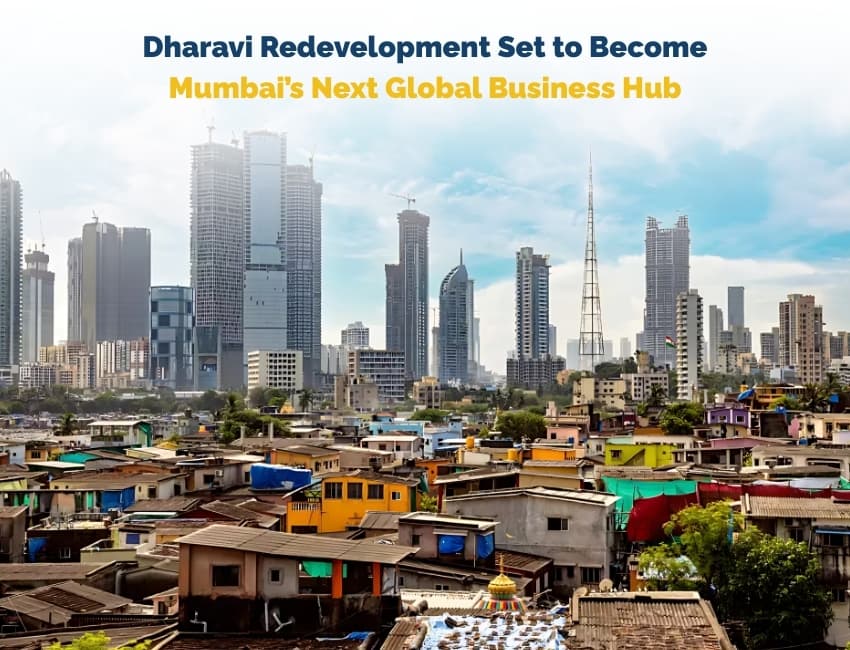
It is a huge Dharavi Redevelopment Project, one of the biggest and complex urban transformation initiatives in the world, set to transform Mumbai's landscape by incorporating the most modern commercial district (CBD). The project, which is estimated at close to Rs96,000 crore, is expected to transform Dharavi's image from Asia's biggest urban slum to a thriving mixed-use urban area.
A Vision Beyond Housing
Dharavi's redevelopment does not limit itself to restoring more than one million people who live in densely compacted settlements. A large portion of the prime land, which is 600 acres located in the heart of Mumbai, is set aside as commercial property. This includes Grade-A office space, High Street retail, coworking hubs, hotels, and infrastructure to support them.
According to those who have been familiar with the plan's outline, the addition of CBD is designed to boost the economic output of Dharavi by three times and create reliable revenue streams to fund other aspects of the rehabilitation. "The CBD will be created from land that is not needed to renovate homes, giving the possibility of integrating Dharavi's existing enterprises into the formal economy," according to a person who is familiar with the planning process.
A Hybrid Approach to Growth
This commercial area is developed with a multi-faceted strategy with a hybrid approach in the back of our minds. While some of the commercial property could be subleased to multinational corporations or large domestic businesses, specific areas will be reserved for small-scale companies and retailers that already are operating within Dharavi.
This method ensures that the current Dharavi's business ecosystem, which is known for its leather products, pottery, textiles, and recycling sectors, doesn't become dislocated. Instead, it will be upgraded with the latest infrastructure, support from the regulatory authorities, and enhanced access to markets.
Experts believe that this will not just officially formalize the informal economy, but also open up new avenues for partnership with business as well as employment and training. "The intention is to expand Dharavi's economy at least 3x and turn Dharavi into a self-sustainable economic centre," the person added.
Gain from Connectivity
Connectivity is predicted to be among the biggest advantages for the district. The Mumbai Metropolitan Region Development Authority (MMRDA) has appointed the official agency to oversee the nearby transport hub that is multimodal, and is currently working on connecting Dharavi to major metro lines, as well as suburban railway lines and arterial roads.
The integration of transport makes the commercial area very accessible, a feature that will attract businesses looking for centrally-located retail and office space in Mumbai. Mobility improvements are also likely to benefit residents and employees within Dharavi, which will create an integrated connection between working, living, and commuting.
Adani Group's Role in the Project
The Dharavi Redevelopment Project has been given to Adani Group through a joint partnership with the Maharashtra government, under a specific designated vehicle (SPV) called Navbharat Mega Developers Pvt Ltd (NMDPL). The SPV will be responsible for the rehabilitation, resettlement, infrastructure development, and the development of a brand new district for business.
Adani Group has outlined its goal of creating an integrated ecosystem that is balanced between residential, social, and commercial. Over 12,000 commercial businesses currently operating in Dharavi's non-organised sector will be formalised, giving companies better working conditions and legal recognition.
Setting a Benchmark for Urban Redevelopment
Urban planners and experts on infrastructure consider that the Dharavi transformation, when it is executed successfully, can be a case study for the entire world in the field of inclusive urban development. "For Dharavi's commercial district to be successful, it has to be seamlessly integrated into Mumbai's infrastructure and placed in a position to compete against other business districts like BKC as well as Lower Parel," said an urban infrastructure planner.
The commercial aspect is expected to generate permanent employment opportunities, boost Mumbai's standing as a major financial center, and transform Dharavi's image from a secluded settlement to a modern-day business district.
Current Progress
The work has already begun on the initial stages of the project, which include thorough surveys, resettlement plans, and the design of infrastructure. Authorities are focused on ensuring that residents are rebuilt within close proximity of their former homes, and commercial businesses are seamlessly transitioned to the official economy.
The next few years will decide the extent to which Dharavi is able to realize this vision of grandeur. If it succeeds, the Dharavi Redevelopment Plan will not just alter the urban landscape of Mumbai but will also be evidence of India's capacity to carry out complex, massive urban transformations.
Source: realty.economictimes.indiatimes
.jpeg&w=3840&q=75)